
The Collective Dinner’s Hidden Contest
A Gentleman in MoscowThis thread follows the political contest staged at the 1954 state dinner and the Count’s role in reading its social signals.
increasing Bearing strength in each event
 decreasing
Bearing strength in each eventdecreasingNo Seating Plan
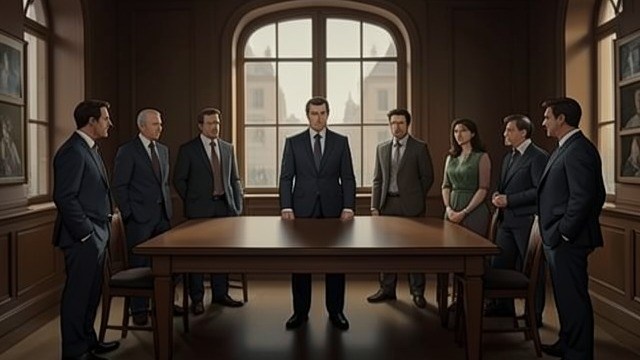
An Empty Diagram
The Assignment
Count Alexander Ilyich Rostov prepares the room for a dinner of the Presidium and Council of Ministers. The Kremlin liaison says there will be no formal seating chart.
A Political Test
The Count understands that guests will reveal the real hierarchy by choosing seats. A seemingly simple arrangement becomes an unspoken contest for influence.
The Leaders Choose Their Places
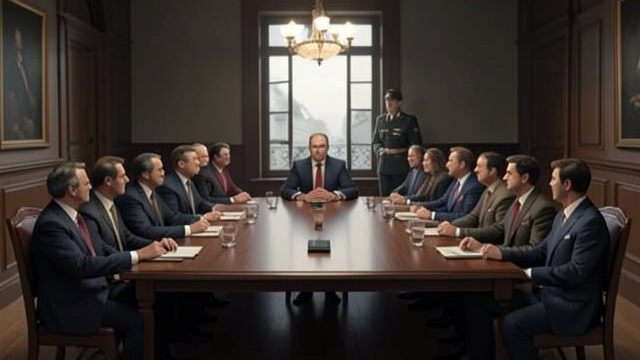
Hierarchy in Motion
The U-Shaped Table
Forty-six officials enter suite 417 and take seats without an announced plan. Their movements establish the center of power more clearly than any written instruction could.
Khrushchev’s Timing
Nikita Khrushchev waits until others settle before taking the final chair beside Georgy Malenkov. His composure suggests both foreknowledge and confidence.
A Toast Changes the Room
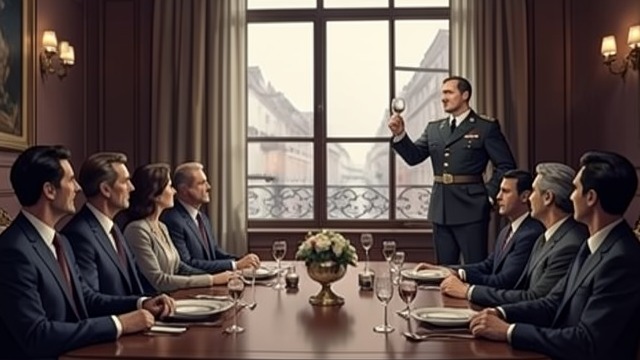
Khrushchev’s Performance
A Historic Reference
Nikita Khrushchev toasts the hotel’s history and recalls a previous political meeting inside The Metropol. The reference turns a formal meal into a carefully staged historical moment.
Malyshev Summoned
Khrushchev invites the guests to the windows to hear Vyacheslav Malyshev announce the success of the Obninsk facility. The General Secretary directs the audience’s attention toward a spectacle he has helped shape.
Moscow Goes Dark

The Power Demonstration
A Citywide Outage
As the new plant begins feeding the Moscow grid, the lights go out across large districts, including the Kremlin and The Metropol. Officials experience the interruption as a moment of uncertainty.
Brightness Restored
The lights return in a visible wave, and the gathered leaders applaud. The demonstration recasts nuclear energy as civic progress while advancing Khrushchev’s political position.
A Report Hidden for Paris

The Count’s Political Reading
The Social Evidence
Count Alexander Ilyich Rostov records who knew the dinner’s setting, who sat beside whom, and how Malenkov was left waiting. His account interprets the ceremony as a maneuver in the leadership struggle.
A Second Purpose
The report travels concealed in Sofia’s belongings to Richard Vanderwhile. It converts the Count’s service experience into information that may help his daughter and inform a foreign observer.
11 June 1954, afternoon
11 June 1954, 9:00 p.m.
11 June 1954, 10:50 p.m.
11 June 1954, 11:00 p.m.
21 June 1954
